
If you’ve recently opened a cabinet maker’s catalog, you’ve probably noticed those shiny, mirror-like high-gloss doors that seem to bounce light around and make the kitchen look completely different. Many customers, when trying to decide between a high-gloss cabinet and a regular (matte) cabinet, aren’t exactly sure how these two differ in material, durability, and upkeep. In this post, we’ll break it all down in simple terms so that by the end, you’ll be able to make the best choice for your own kitchen.
What Is a High-Gloss Cabinet?
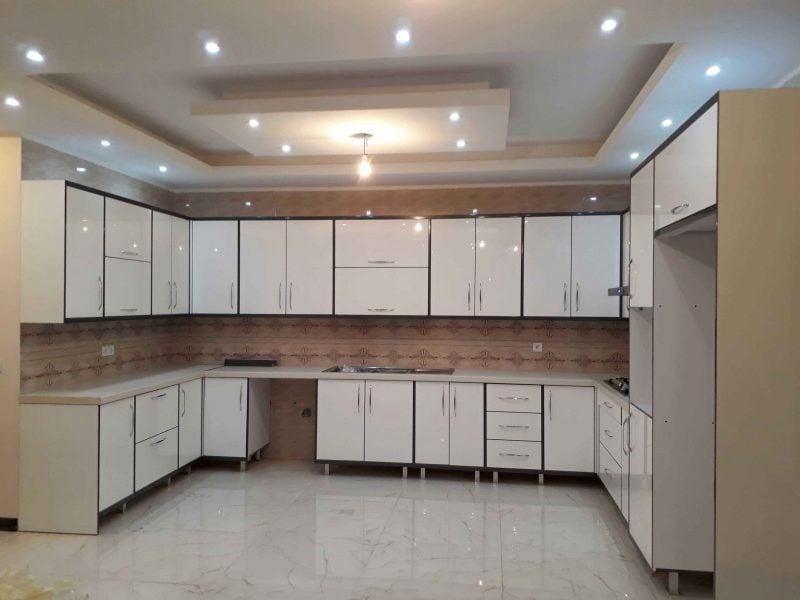
High Gloss literally means “extremely shiny,” and that word perfectly describes this type of cabinet. A high-gloss cabinet is actually a subcategory of MDF cabinets: the core of the door is made from raw MDF board, but a layer of plexiglass coating (a type of polycarbonate that resembles glass) is applied over it. This coating is what gives the cabinet its smooth, polished, mirror-like surface — so much so that you can see your own reflection in it.
Interestingly, contrary to what many believe, this coating has nothing to do with actual glass. It only resembles glass in appearance, while being lighter in weight and far more resistant to breaking.
What Is a Regular (Matte MDF) Cabinet?
When we say “regular cabinet,” we usually mean MDF cabinets finished with a more matte coating — such as melamine or PVC — instead of the glossy plexiglass layer. These cabinets have a simpler look without the mirror-like shine, but as we’ll see below, they actually outperform high-gloss in several practical areas.
The Key Differences Between High-Gloss and Regular Cabinets
Now let’s compare these two cabinet types across several important factors:
1. Appearance & Shine
This is the most obvious difference. With its glossy, reflective surface, a high-gloss cabinet spreads light throughout the space, making the kitchen look brighter, bigger, and more modern — which is why it’s a popular choice for small or dimly lit kitchens. Regular cabinets, on the other hand, have a calmer, matte surface more suited to classic, neoclassical, or understated minimal styles.
2. Scratch Resistance
Here, regular cabinets come out ahead. While the glossy surface of high-gloss cabinets is eye-catching, it’s more sensitive to impact and scratches — especially in darker colors, where scratches show up much more clearly. Regular cabinets with a matte coating, thanks to their non-mirror surface, hide these scratches better and are a safer choice for high-traffic kitchens.
3. Moisture Resistance
A common misconception is that because high-gloss looks like glass, it must be waterproof. In reality, the core of both cabinet types is MDF, which is inherently sensitive to moisture. Only the surface with the plexiglass coating has good water resistance; the edges and back of the cabinet, if not properly protected with a suitable coating (like melamine), remain vulnerable to moisture damage. In this respect, high-gloss and regular cabinets are in roughly the same boat.
4. Daily Cleaning & Maintenance
Both have their pros and cons here. Thanks to its smooth, non-porous surface, a high-gloss cabinet can be cleaned easily with just a damp cloth — but because the surface is so shiny, fingerprints and grease marks show up very easily, requiring more frequent cleaning. Regular cabinets don’t have this issue as much, since stains are less noticeable, though fully cleaning a matte surface sometimes takes a bit more effort.
5. Edges & Safety
One lesser-known difference is the edge type. High-gloss cabinets typically have sharper edges, while many regular cabinets (especially membrane-coated models) come with softer, rounded edges. If you have small children at home, this is worth keeping in mind.
6. Repair & Restoration
Another advantage of high-gloss is the ability to polish and restore the surface — meaning minor scratches can often be buffed out to some extent by a professional (though this requires skilled handling, as improper sanding can ruin the original shine). Regular cabinets, particularly membrane-finished ones, usually need to go back to a specialized workshop for repair, and matching the exact original color can sometimes be difficult.
7. Price
Generally speaking, high-gloss cabinets cost more than regular cabinets with simple melamine coating, due to their manufacturing process and special coating — though this price gap can vary depending on the sheet brand (domestic or imported) and coating quality. If you’re on a tighter budget, regular cabinets are usually the more affordable choice.
8. Color Variety & Pairing with Other Materials
Both cabinet types come in a wide range of colors, but high-gloss is generally more popular in lighter shades (especially white), since it shows off its shine better and pairs well with smaller spaces. High-gloss also pairs easily with stone, steel, or even wood countertops, giving it great flexibility in modern decor.
Which One Is Right for Your Kitchen?
The truth is, neither option is absolutely “better” — the right choice depends entirely on your lifestyle and priorities:
- If you want a modern, shiny, luxurious look and have a small or dimly lit kitchen, high-gloss is a fantastic choice.
- If you have a large family, a high-traffic kitchen, and don’t want to constantly worry about scratches and fingerprints, regular cabinets are the more practical option.
- If you’re on a limited budget, regular cabinets usually cost less overall.
- If your decor style is classic or neoclassical, it’s best to skip high-gloss altogether, since this material is designed for modern spaces and doesn’t suit classic decor.
A Practical Tip: Combining Both
Many interior designers today, instead of choosing purely one or the other, recommend combining high-gloss and matte cabinets — for example, light-colored high-gloss upper cabinets to reflect light, paired with matte-finished base cabinets for better resistance to everyday impact and stains. This combination preserves the modern beauty of high-gloss while adding the practical durability of regular cabinets to the kitchen.
Final Thoughts
High-gloss and regular cabinets are both built on the same foundation (MDF), but their different coatings create a completely different experience — from appearance and shine to durability, maintenance, and even price. The best choice is the one that fits your daily lifestyle, budget, and decor taste.
If you’re still not sure which option suits your kitchen best, Behinewood’s team of experts is always ready to guide you in choosing the right countertop, coating, and cabinet material based on your project’s real needs.